You have no items in your shopping cart.
Using a Check Cord for Training
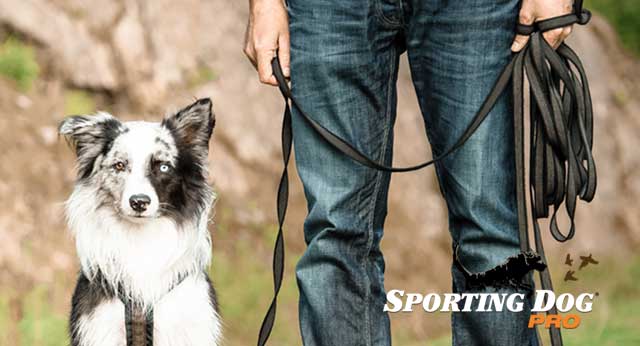
Ask professional gun dog trainers what single piece of equipment they’d be least willing to give up, and the check cord comes up repeatedly. It’s a simple tool — a length of stiff, tightly woven cord with a snap on one end — but it solves a problem that no other training tool addresses as cleanly: how do you maintain physical control of a dog at distance, enforce commands in the field, and do it all without being right next to him? The check cord is the answer to that question, and it’s been the answer for working dog trainers for generations.
What a check cord is and what makes one good
A check cord is not a leash. A leash is used to keep a dog close beside you; a check cord is used to maintain control of a dog working at distance in front of you. The distinction matters because the mechanics are different and confusing the two produces poor results with both tools.
A quality check cord is tightly braided — stiffer than a leash — which prevents it from tangling and looping around legs, cover, and brush as the dog moves. High visibility cord is preferable because you will eventually drop the cord and let it drag while the dog works; being able to see it at a distance and in cover is practical. Length typically runs 20 to 30 feet depending on the application and the trainer’s preference. The snap closure needs to be durable and easy to attach and release quickly. The cord attaches to a flat collar with a D-ring — not a choke or prong collar, which creates unpredictable feedback when the cord is dragging.
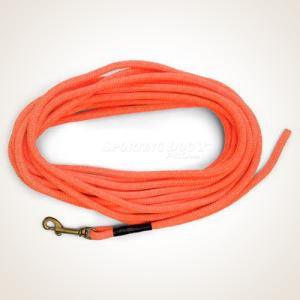
$28.49

Lightweight 30-foot check cord for steadiness training on young bird dogs. High-visibility orange, soft on the hands, tangle-free, and easy to coil. Thirty feet is enough range to let a dog find birds and flash point — close enough to enforce a stop or recall when it matters... [read more].
When to introduce the check cord
The check cord is not a beginner tool. Introducing it before the dog has the foundational obedience to make use of it produces confusion and frustration — for the dog and the trainer. The dog should reliably understand and respond to the commands you plan to reinforce with the cord before the cord enters the picture.
Specifically: the dog should know sit, stay, here, and heel on the leash with reasonable consistency before you extend those behaviors to check cord range. A dog that doesn’t hold a sit reliably on a six-foot leash isn’t ready to practice it on a thirty-foot cord in a field. Build the foundation with the leash, prove the behavior at close range, then use the cord to extend that proven behavior to greater distance. Rushing this sequence wastes training time and can install bad habits that take longer to fix than they would have taken to prevent.
The check cord isn’t teaching the command — it’s extending a command the dog already understands to a greater working distance. The dog that struggles with the check cord is almost always a dog who didn’t have solid enough foundation before the cord was introduced. Go back to leash work, not forward with the cord.
How to use it — the three core applications
Stay with me. Attach the cord to the collar, let the dog move out to working distance, and use light cord pressure to keep him from ranging beyond the range you want. The pressure communicates the boundary without you having to be physically present at that boundary. Praise non-verbally when he respects the limit — a pat or a calm, approving sound — rather than verbal commands that may bleed into other training cues. The goal is a dog that understands the cord as a communication channel, not a restraint device.
Go with me. With the dog at heel or close position, take a step forward and give a few light, quick tugs as you move. The dog learns to follow your pace and direction changes with the cord as the guide. Change pace and direction frequently during this exercise. The dog should be tracking your movement, not cutting corners or ranging ahead. Correct deviations immediately with a cord tug and redirect to the correct position. This builds the close-working attentiveness that makes a hunting partner genuinely useful in the field.
Come to me. Once the dog understands “go with me,” recall at cord distance is the natural extension. Use a light cord pull rather than the verbal “here” or “come” command initially — the goal is to develop the cord pull itself as a recall cue that functions independently of the voice command. The cord pull recall is particularly valuable in field conditions where voice commands don’t carry, where the dog is heavily distracted, or where an e-collar isn’t yet in the picture.
Progression and distance
Work close before you work at distance. Start with the dog five to ten feet out and build to the full cord length only when the behavior is solid at shorter distances. If you lose control at any distance — the dog blows through a cord pressure cue, doesn’t respond, or the behavior deteriorates — go back to the shorter distance where it worked. Reliability at ten feet is more valuable than occasional compliance at thirty.
Eventually the cord is dropped and drags behind the dog as he works. At this stage the cord is a psychological anchor — the dog has been conditioned to respond to cord pressure and the presence of the cord on his collar reinforces the expectation even when you’re not holding the other end. This is the transition stage between leash-enforced behavior and fully off-leash reliability. Don’t skip it by going straight to off-leash before the behavior is truly solid.
Other field applications
Beyond the three core commands, experienced handlers find additional uses for the check cord that emerge naturally from working with it. Keeping a retriever from breaking and entering the water before the send command. Preventing a pointing dog from creeping on another dog’s point. Holding a flusher at wing and shot while the bird is in the air. In each case the cord provides the physical backup that makes the enforcement of an already-known command possible at moments when the dog’s drive is running hard and voice commands alone don’t reach.
The check cord works alongside the e-collar, not instead of it. Most serious gun dog trainers use the check cord to build and proof behaviors in the early and intermediate stages of training, then introduce the e-collar to extend those proven behaviors to the distances and conditions of actual field work. The cord teaches the behavior. The collar maintains it when the dog is beyond cord range.
Short, focused sessions produce better results than grinding the dog through extended repetitions. Fifteen to twenty minutes of quality check cord work is enough for most dogs in a session. End on a success, praise clearly, and put the cord away. A dog that finishes a session having done something right and been praised for it comes back to the next session ready to work.