You have no items in your shopping cart.
Tips for Traveling In The Car With Your Dog
For hunters, the dog in the truck is as much a part of a hunting trip as the gun. A retriever, pointing dog, or hound that travels comfortably, loads and unloads on command, and settles quietly in a crate between destinations makes every aspect of the trip easier. A dog that’s anxious in the vehicle, destructive when left, or a distraction while you’re driving creates problems that compound over a long haul to the field. The difference is almost entirely a product of early exposure and proper containment.
Introduce car travel early and associate it with good things
The easiest time to make a dog comfortable in a vehicle is early in his life, before he has a chance to develop anxiety or negative associations. A puppy introduced to car rides as part of normal life — short trips, trips that end somewhere good, trips that don’t always mean a vet visit — learns that the car is a neutral-to-positive part of the world. A dog that only enters a vehicle for appointments and stressful events learns to associate the car with stress.
Start with short rides and work up. Let the puppy get in and out of the vehicle on his own terms before any travel happens. Reward calm behavior in the crate. The goal is a dog that loads readily, settles quickly, and doesn’t need managing while you’re driving. That dog develops naturally from consistent positive exposure. He doesn’t develop from occasional car trips where the dog is anxious and the handler is managing the situation rather than driving.
Teach a specific load command early — “kennel” or “load” — and enforce it consistently. A dog that loads on command when you open the truck is dramatically easier to manage than one you’re physically lifting or coaxing in. It also becomes a safety behavior: a dog that waits for the command before exiting the vehicle isn’t bolting out onto a highway when you open the door in a parking lot.
Containment is safety, not punishment
A loose dog in a moving vehicle is a hazard to the driver, to himself, and to other occupants. In a sudden stop or accident, an unrestrained dog becomes a projectile. Beyond that, a dog that’s loose in a truck cab is likely to interfere with driving — climbing over the center console, reacting to things outside the window, or demanding attention. This is genuinely dangerous.
A properly fitted crate in the truck bed or cargo area is the standard solution for hunting dogs. The crate keeps the dog secure, gives him a defined space, reduces his anxiety by providing an enclosed den-like environment, and protects him in a collision far better than being loose or even in a seat harness. For smaller vehicles or dogs that travel in the cab, a seat harness that clips to the seatbelt is better than nothing, but a crate in the cargo area is significantly safer.
The crate should be large enough for the dog to stand, turn around, and lie down comfortably, but not so large that it slides around or allows the dog to be thrown across the interior in a hard stop. It should be secured so it can’t move. A crate that shifts and bangs against the truck walls creates a stressful environment and can injure the dog. Our Zinger aluminum dog crates are built specifically for working dogs traveling in trucks and SUVs — ventilated, airline-rated, available in sizes for every breed, and designed to take the abuse of regular field use.
Never leave a dog in a parked vehicle in warm weather, even briefly. On an 85-degree day, vehicle interior temperatures can reach 120 degrees or more within 20 minutes. A dog in a closed vehicle in summer heat can die in the time it takes to run into a gas station. If the vehicle isn’t running with air conditioning, the dog doesn’t stay in it.
Motion sickness and anxiety
Some dogs get carsick, particularly on their first experiences with vehicle travel or on long trips with winding roads. Signs include excessive drooling, yawning, lethargy, or vomiting. Feeding a full meal right before a trip significantly increases the risk — don’t feed within two to three hours of departure for any trip of significant length. A dog that handles short trips without issue may still get sick on a three-hour drive, so err on the side of an empty stomach when the route or duration is uncertain.
Dogs that continue to experience significant motion sickness or travel anxiety despite gradual exposure and proper crating may benefit from medication. Your veterinarian can recommend appropriate options. Don’t use human dramamine without checking with your vet first — the dosage and formulation appropriate for dogs differs from what’s appropriate for people.
For anxiety specifically, the same exposure-based approach that works for other anxious behaviors applies here: graduated exposure starting with very short trips, ending in positive experiences, building duration and distance gradually over many sessions. Most dogs work through travel anxiety with this approach. The ones that don’t may genuinely need medical support as a bridge.
Comfort and management on long trips
On any trip over two to three hours, plan for regular stops to let the dog stretch, relieve himself, and drink water. Dogs generally need a break more frequently than people do, and an older dog or a large breed will stiffen up faster than a young athletic dog. Every two hours is a reasonable interval for most dogs. Bring water from home if your dog is finicky — some dogs won’t drink water that smells different from what they’re used to.
Give the dog something to occupy him in the crate for long hauls — a chew, a bully stick, or a stuffed Kong keeps him focused on something constructive rather than alerting to everything outside the window. A dog that barks at passing trucks for four hours is a dog that arrives at the destination stressed and wound up. A dog that was occupied and rested arrives ready to work.
The head-out-the-window issue
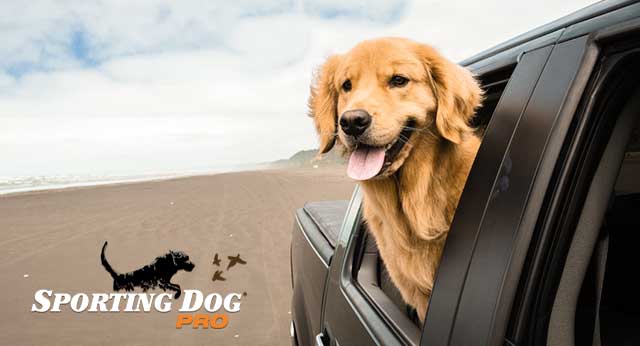
It’s a classic image and genuinely enjoyable for the dog, but a dog with his head out a moving window at highway speed is at real risk of eye injury from debris, insects, and the sustained wind exposure that dries the cornea and can cause serious irritation requiring veterinary treatment. For occasional low-speed drives on country roads it’s probably fine; for highway travel, keep the windows up enough that the dog can’t fully extend his head out.
A dog that loads reliably, travels quietly, and arrives at the destination settled is a dog that was prepared for vehicle travel from the beginning. If your current dog isn’t there yet, it’s never too late to start — the same gradual, positive exposure approach works on adult dogs, it just takes a little more time than it does with puppies.