You have no items in your shopping cart.
Tips for Curbing My Dog's Separation Anxiety

Separation anxiety in dogs ranges from mild discomfort when left alone to a full-scale behavioral crisis that results in destruction, self-injury, and neighbors calling about the noise. The approach that helps a mildly stressed dog settle while you’re at work is not the same approach that helps a dog in genuine panic. Before getting into management techniques, it’s worth understanding what separation anxiety actually is and what it isn’t — because misidentifying the problem leads to applying the wrong solution.
Understanding what you’re dealing with
True separation anxiety is a specific fear response triggered by the anticipated or actual absence of an attachment figure — typically the primary handler, though some dogs attach to multiple people or even other pets. The dog isn’t acting out from boredom or lack of exercise, though those things can look similar. He’s experiencing genuine distress, and the behaviors that result — barking, howling, destructiveness, inappropriate elimination, attempts to escape — are symptoms of that distress, not deliberate misbehavior.
Distinguishing anxiety from boredom matters because the interventions are different. A bored dog with excess energy who chews things and barks when left alone may respond well to more exercise and mental engagement. A dog with genuine separation anxiety may be fully exercised and mentally stimulated and still panic the moment the door closes. If you’re not sure which you’re dealing with, a video recording of what the dog does in the first thirty minutes after you leave is the most reliable diagnostic tool — a dog that settles within a few minutes is probably bored or attention-seeking; a dog that continues escalating is anxious.
Build independence through obedience training
The original article makes a connection that’s worth developing: there is a genuine relationship between a dog’s obedience foundation and his ability to be alone. A dog that has been trained to follow commands reliably, that understands what is expected of him in various situations, and that has learned to look to the handler for direction rather than acting on his own anxiety — that dog has a level of confidence and self-regulation that an untrained dog doesn’t have.
Obedience training doesn’t cure separation anxiety directly, but it builds the handler relationship and communication clarity that make behavioral modification more effective. A dog that understands commands, responds to your cues, and has experienced consistent handling develops trust in the handler that partially extends to time away from the handler. Start with basic obedience if it isn’t already solid — sit, stay, down, recall — before layering in separation-specific training.
Desensitize departure cues
Most dogs with separation anxiety develop hypervigilance to their owner’s pre-departure routine. They learn that shoes going on, keys being picked up, and a jacket being grabbed means the owner is about to leave, and they begin the anxiety response before the door ever closes. By the time you’re out of the house, the dog is already wound up.
The fix is to break the association between those actions and departure. Put your shoes on and then sit down for twenty minutes. Pick up your keys and walk around the house without leaving. Grab your jacket, put it back. Repeat these actions frequently enough that they stop predicting departure reliably. When the predictive value of those cues decreases, the anticipatory anxiety decreases with it.
This takes time and patience across many repetitions. The goal isn’t to trick the dog — he’ll eventually figure out you’re still leaving sometimes. The goal is to eliminate the automatic anxiety spike that starts before you leave so the departure itself becomes a more manageable event.
Graduated departures — the core behavioral intervention
The most effective behavioral approach for separation anxiety is systematic desensitization: exposing the dog to absences at a duration below the threshold that triggers anxiety, then very gradually increasing that duration as the dog demonstrates he can handle each level without distress. This is slow, methodical work that produces genuine change in the dog’s response rather than just management of the behavior.
Start with absences of thirty seconds to a minute — long enough to be a real departure, short enough that the dog doesn’t have time to escalate. Return before the anxiety response starts. Do this many times over multiple sessions. When the dog is reliably calm at one minute, extend to two. Then five. The increments should be small enough that you’re always operating below the anxiety threshold, not pushing through it.
The duration that triggers anxiety is different for every dog. Some dogs are fine up to thirty minutes and then panic. Others begin distress within thirty seconds of the door closing. Know your dog’s threshold before you start and begin below it, not at it.
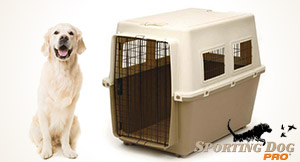
A crate, used correctly, is not a solution for separation anxiety on its own — a panicking dog in a crate is a panicking dog with fewer degrees of freedom, which can make things worse. But a dog that has been crate-trained positively from puppyhood and sees the crate as a comfortable, safe den is often more settled in the crate when alone than he would be loose in the house. The Zinger aluminum crates we carry are well-ventilated and built to be a dog’s actual den — not a confinement box.
Don’t discipline fear-based behavior
Disciplining a dog for what he did while you were gone is ineffective at any time — the connection between the behavior and the consequence is too remote for the dog to make — and specifically counterproductive with anxiety. A dog that was distressed while you were gone and is then corrected when you return learns that your return is associated with an aversive consequence, which may increase his anxiety about the departure-and-return cycle rather than reducing it.
Return home calmly, without dramatic emotional reunions that spike the dog’s arousal, and without anger about what you find. If there was destruction or elimination in your absence, clean it up and work on addressing the underlying anxiety. The calm, low-key return is part of the treatment: teaching the dog that departures and returns are low-stakes non-events rather than emotionally significant experiences.
Managing the behavior while you work on the problem
Behavioral modification through graduated departures takes weeks to months. In the meantime, you may need to manage the behavior to protect your property, your dog, and your neighbors.
Exercise before you leave depletes some of the physical energy that would otherwise fuel the anxiety response. Mental engagement — a stuffed Kong, a puzzle feeder, a long-lasting chew introduced only when you leave — gives the dog something to focus on in the first minutes, which is often the most critical window. A soothing audio environment (television or music left on) can reduce the contrast between your presence and your absence.
For dogs whose separation anxiety primarily manifests as nuisance barking, a bark collar can manage the behavioral symptom while you work on the underlying cause. It won’t resolve the anxiety itself, but it can protect your relationship with neighbors and reduce the rehearsal of an anxiety behavior pattern. As with any tool, use it as part of a broader management plan rather than as a standalone solution.
When to involve a professional
Mild to moderate separation anxiety often responds to the management approach described here when applied consistently. Severe separation anxiety — a dog that injures himself attempting to escape, that cannot tolerate any absence regardless of duration, that fails to improve with weeks of systematic work — warrants professional evaluation. A veterinary behaviorist or certified applied animal behaviorist can assess the dog’s specific situation and, in severe cases, recommend medication to reduce the physiological anxiety response enough to make behavioral modification possible. Medication isn’t a substitute for behavioral work, but for severe cases it’s often a necessary bridge to make that work effective.
Your regular veterinarian is the right first contact for a referral and to rule out any medical contributions to the behavior.