You have no items in your shopping cart.
The Dangers of Dog Obesity
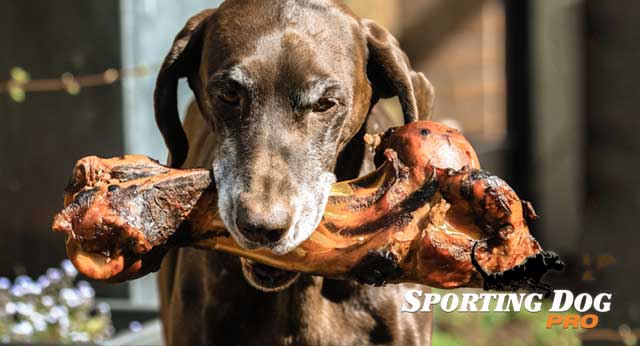
More than half of dogs in the United States are overweight or obese. That number has been reported consistently by the Association for Pet Obesity Prevention for years, and it hasn’t improved. For the average house dog, excess weight shortens life and degrades quality of life. For a working gun dog, it does all of that and also directly limits what the dog can do in the field — his endurance, his joint health, his heat tolerance, and his career length are all affected by carrying extra weight. A dog that arrives at hunting season overweight is a dog you’re starting at a disadvantage you created in the off-season.
How to tell if your dog is overweight
Dogs carry weight differently than people, and extra pounds aren’t always obvious from looking at the dog from above, especially on thick-coated breeds. The most reliable assessment is hands-on. Run your hands along both sides of the dog’s ribcage — you should be able to feel each rib distinctly without pressing hard. If you have to push through a layer of padding to feel them, or if you can’t feel them at all, the dog is carrying too much weight.
Standing over the dog and looking down, there should be a visible waist — a narrowing between the ribcage and the hips. Viewed from the side, there should be an abdominal tuck — the belly should rise slightly from the ribcage toward the hindquarters rather than hanging level or sagging. A dog with no visible waist from above and a flat or sagging belly from the side is overweight. A stomach that sags noticeably, a back that appears rounded or wide, and difficulty feeling the spine are all additional indicators.
Body condition scoring — a standardized 1-to-9 scale used by veterinarians — is the most precise tool for ongoing monitoring. A score of 4 to 5 is ideal for most breeds. Ask your vet to show you what that looks like on your specific dog so you have a calibrated reference point rather than guessing.
A useful check: can you feel your dog’s ribs easily without pressing? Is there a visible waist when viewed from above? Is there an abdominal tuck from the side? If the answer to any of those is no, the dog is likely overweight. Your vet can confirm with a body condition score.
What excess weight actually does
Joints and orthopedic health. This is the most immediate and most damaging consequence for a working dog. Every extra pound of body weight adds roughly four to five pounds of force to the joints with each stride. A dog carrying ten pounds of extra weight is subjecting his elbows, hips, shoulders, and stifles to significantly elevated stress with every step — across an entire hunting day, that adds up to an enormous cumulative load. The result is accelerated development of arthritis and degenerative joint disease that shortens the working career and the comfortable years of life. Overweight dogs develop arthritis earlier, progress faster, and have more severe symptoms than dogs maintained at ideal weight.
Cardiovascular and respiratory function. The heart works harder to circulate blood through additional mass. The respiratory system carries the increased oxygen demand of a larger body. For a dog working hard in the field — particularly in warm weather — those additional demands translate directly into reduced endurance, faster fatigue, and significantly greater heat stress risk. An overweight dog working in September heat is a dog at genuine risk of heat exhaustion well before he would be at ideal weight.
Diabetes. Obesity is the primary risk factor for Type 2 diabetes in dogs. An overweight dog’s cells become insulin-resistant over time, requiring the pancreas to produce increasing amounts of insulin to manage blood sugar. Eventually the pancreas can’t keep up, blood sugar regulation fails, and diabetes develops. Managing canine diabetes is expensive, requires lifelong daily insulin injections, and doesn’t resolve the underlying condition — it only manages it. Prevention through weight management is dramatically preferable.
Heart disease. Obesity increases the workload on the heart chronically, contributing to cardiac enlargement and dysfunction over time. Heart disease in dogs is often caught late because symptoms develop gradually and dogs compensate well until the disease is advanced. Maintaining healthy weight is one of the most practical things you can do to reduce cardiac risk.
Shortened lifespan. Studies consistently show that dogs maintained at ideal body weight live significantly longer than overweight dogs — in some research, up to two years longer. For a dog expected to work into his later seasons, those years matter. The dog that stayed lean and fit throughout his life is the one still hunting at ten.
Why it happens and who’s responsible
Obesity in dogs almost always comes down to calories in versus calories out, and the dog has no control over either side of that equation. You control what he eats and how much exercise he gets. A dog that is overweight has an owner who is feeding too much, exercising too little, or both. There is no judgment in that statement — it’s just where the accountability sits, and it’s where the solution has to come from.
The most common contributors are overfeeding relative to actual activity level, generous treat giving without accounting for those calories in the daily total, feeding table scraps, and insufficient exercise particularly during the off-season. Dogs that are highly active during hunting season and then largely inactive for the rest of the year are particularly prone to off-season weight gain if food intake isn’t adjusted to match the reduced activity.
Some dogs have medical conditions that contribute to weight gain — hypothyroidism and Cushing’s disease are the most common. If a dog is gaining weight despite appropriate feeding and exercise, a veterinary workup to rule out endocrine disease is worth doing before assuming it’s purely dietary.
Dogs need far fewer calories than most owners assume. The APOP caloric needs calculator is a useful starting point for figuring out how much your dog actually needs based on his weight and activity level — the numbers often surprise people.
Managing it
Obesity is a disease, not just a cosmetic concern, and it’s treated accordingly — through a combination of dietary adjustment and increased exercise, ideally under veterinary guidance. There is no quick fix. The same patience and consistency that applies to dog training applies here.
On the feeding side: measure food rather than estimating portions, account for treats in the daily calorie total, eliminate table scraps, and feed according to your dog’s ideal weight rather than his current weight. Your vet can give you a target weight and a calorie target to work toward. Switching to a lower-calorie food formulation is often more practical than dramatically reducing portions of a calorie-dense food.
On the exercise side: regular, consistent physical activity is the other half of the equation. For a gun dog in the off-season, that means structured exercise — runs, field work, swimming — not just casual time in the yard. A dog that burns calories regularly is easier to keep at healthy weight than one who gets irregular bursts of intense activity with long sedentary stretches in between.
Monitor progress monthly with body condition assessment rather than just relying on the scale. Weight loss in dogs should be gradual — about one percent of body weight per week is a sustainable, healthy rate. Faster than that, and you risk muscle loss alongside fat loss. Slower is fine; what matters is consistent, steady progress in the right direction.