You have no items in your shopping cart.
Successful Communication With Your Gundog
The training relationship between a hunter and a gun dog is a communication relationship. The dog is constantly sending information — through posture, movement, tail carriage, ear position, pace, and vocalization. The hunter is constantly sending information back — through body position, hand signals, whistle, voice, and in the field, through an e-collar. The quality of the partnership depends on how well both sides of that channel work. Most training problems trace back to a communication breakdown, not a bad dog.
Your dog reads you better than you read him
Dogs have been studying human body language for thousands of years. Your dog notices things you don’t know you’re doing — the direction of your eyes, the angle of your shoulders, the tension in your posture, the subtle change in your movement before you reach for his collar. Research has demonstrated that dogs follow human gaze and pointing gestures with a sophistication that most other animals, including primates, don’t match. He is watching you constantly and reading more from your body than from your words.
This matters for training because what you say and what your body communicates are often different things, and your dog pays more attention to the body. A handler who is tense and anxious communicates anxiety to the dog regardless of how calm his voice sounds. A handler who is uncertain about a command communicates that uncertainty. Dogs are sensitive readers of emotional state, and they respond to it. This is why some dogs seem to perform differently for different handlers using identical commands — the handler’s body language is different, and the dog responds to that.
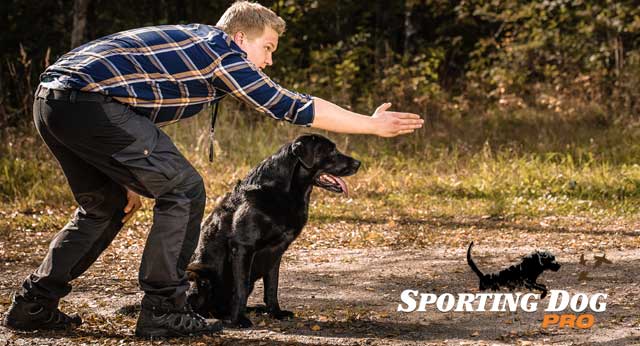
In early training, use clear, exaggerated physical cues alongside your verbal commands. The long throw that teaches a young retriever to mark, the arm signal that teaches a flusher to range, the deliberate body position that teaches a pointer to hold — these physical signals often carry more weight initially than the words. As the dog becomes trained, you can reduce the exaggeration. In the field, where voice commands may not carry and the dog may be working at distance, those physical signals and whistle cues often become the primary communication channel anyway.
Consistency is what the dog is counting on
Dogs don’t tolerate inconsistency in communication the way humans do. A command that means one thing on Tuesday and a different thing on Saturday because you’re in a hurry, or because your tone was different, or because you followed through on it last week but let it slide this week — that inconsistency is genuinely confusing to a dog. He’s not being stubborn when he doesn’t respond reliably to a command you gave inconsistently. He’s responding to the training he actually received, which was variable.
The practical standard: a command means the same thing every time, from every person who works the dog, in every environment. Sit means sit whether you’re in the yard or in the field. Here means here whether there’s a bird in front of the dog or not. The moment a command becomes negotiable — enforced sometimes, ignored other times — you’ve trained the dog that the command is optional. Rebuilding from that takes longer than building it right the first time.
When a dog responds correctly and the handler doesn’t acknowledge it, that’s also a communication failure. Consistent praise or reward for correct responses is how the dog learns what you actually want. The correction teaches him what not to do. The reward teaches him what to do. Both halves of that equation need to be consistent.
Reading apprehension correctly
For gun dogs in particular, apprehension is one of the most important signals to learn to read — and one of the most commonly misread. A dog that slows down, drops her head, tucks her tail slightly, avoids eye contact, or starts sniffing the ground obsessively in a training context isn’t being lazy or difficult. She’s communicating discomfort or uncertainty about the situation she’s in.
The instinctive responses to perceived threat — flee, fight, or freeze — are hardwired. A gun dog that freezes on a new situation isn’t defective; she’s uncertain. The correct response is to address the uncertainty, not push through it with force. Gradual, consistent exposure to the thing causing the apprehension — at a level that doesn’t trigger the full stress response, then slowly building — is what resolves it. A dog that learns the scary thing isn’t actually a threat becomes more confident every time. A dog that’s pushed past her threshold learns that the situation is genuinely dangerous and becomes harder to work with over time.
For most sporting breeds, apprehension around unfamiliar situations is learned and can be unlearned through patient, systematic exposure. Gun dogs that hunt confidently in varied terrain, around different people, in different weather conditions, and around the noise and activity of a hunting camp got that way through exposure — not because they were born without apprehension.
What his bark is telling you
Vocal communication in dogs is more specific than most owners give it credit for. The bark a dog uses to alert to a stranger at the fence is different from the bark he uses during play, which is different from the yelp of pain or distress, which is different from the howl of a hound on track. Most experienced dog owners develop the ability to distinguish these without thinking about it. Pay attention to that distinction deliberately, especially in training and in the field.
A high-pitched yelp or distress vocalization is your dog telling you something is wrong. That signal should never be suppressed. A nuisance bark — persistent, purposeless barking at nothing in particular — is a different animal entirely, and addressing it with a bark collar is appropriate and effective. The goal of that correction isn’t to silence the dog entirely — it’s to streamline the communication so that when he does bark, it means something. A dog that barks at everything communicates nothing. A dog that barks when there’s a reason to bark is genuinely useful.
A training collar functions the same way — not to instill fear, but to make communication more precise. The e-collar extends the handler’s ability to communicate clearly at a distance, at the moment the relevant behavior is happening. That clarity, applied consistently and at the right level, is what makes the training stick.
Browse our training collar guide for help finding the right system for your dog and your application. Call us at 1 (800) 524-2428 if you want to talk through the options.