You have no items in your shopping cart.
Labrador Retriever
The Labrador Retriever held the top spot on the AKC’s annual most popular breed list for 31 consecutive years — from 1991 through 2022 — the longest reign in AKC history before finally being displaced. The record alone tells you something about how consistently the Lab has earned its place in American homes. What the record doesn’t fully capture is why: a temperament that is genuinely exceptional, versatility that spans waterfowl retriever, upland flusher, service dog, therapy dog, and family companion, and a willingness to work that is matched by very few breeds in the world.
History and origin
Despite the name, the Labrador Retriever did not originate in Labrador. The breed developed in Newfoundland, where fishermen used early Labs — then known as the St. John’s Dog or the Lesser Newfoundland — to retrieve fish that fell from hooks and lines into the frigid waters of the North Atlantic. The name Labrador likely reflects the cold Labrador Current that flows south from the Labrador region along the Newfoundland coast, creating the icy water conditions the breed was selected to tolerate.
British sportsmen visiting Newfoundland in the early 19th century recognized the dog’s exceptional retrieving instinct and brought specimens to England, where formal breed development and controlled breeding produced the modern Labrador Retriever. The breed arrived in the United States in the early 20th century and quickly established itself as the dominant waterfowl retriever in North America. Field trial competition drove selection for the qualities that define today’s working Lab: marking ability, drive, trainability, and physical durability in cold water conditions.
The retrieving instinct and field capability
What distinguishes the Lab as a retriever isn’t simply that he will chase and bring back game — many breeds will do that. It’s the quality and reliability of the retrieve across demanding conditions: the willingness to enter icy water without hesitation, to mark multiple falls accurately under pressure, to take handling to a blind retrieve hundreds of yards away, and to deliver the bird to hand cleanly in a condition fit for the table. A well-bred, well-trained Lab does all of this as part of his natural operating range.
The soft mouth is one of the Lab’s most valued field traits. A soft-mouthed dog carries and delivers game without biting down, chewing, or damaging the bird. Breeders have consistently selected for this quality for generations — it’s frequently cited as a key attribute in litter advertising — and it shows in how consistently the breed delivers birds cleanly. A hard-mouthed dog that crushes birds or strips feathers is a significant liability in the field, and the Lab’s reliable soft mouth is one of the qualities that has kept the breed at the top of waterfowl hunting.
The Lab’s physical attributes support his field work directly. The dense, short, water-resistant double coat provides thermal protection for repeated cold-water entry. The thick, tapering tail — the “otter tail” described in the AKC breed standard — functions as a rudder during swimming, providing directional control that is genuinely useful in current and open water. The muscular, medium-heavy build provides the strength for long-distance swimming without the bulk that would compromise endurance.
For waterfowl hunting applications, browse our waterfowl training collar systems built specifically for retrievers working in and around water — waterproof, long-range, and available in combination e-collar/GPS configurations from SportDOG, Dogtra, Garmin, and DT Systems.
Temperament
The Lab’s temperament is the quality most responsible for its sustained popularity across both working and family contexts. Genuinely stable, tolerant, and handler-oriented, the Lab is one of the few breeds that moves between working hard in demanding field conditions and living comfortably with children and families without difficulty. The drive that produces an exceptional hunter doesn’t produce instability or unpredictability in daily life — it produces a dog that is enthusiastic about work and equally enthusiastic about its people.
Labs are rarely aggressive and reliably gentle with children. Protectiveness is not a dominant trait in the breed; the Lab that alerts a family to danger does so from attentiveness rather than aggression. This quality — the combination of genuine drive and genuine gentleness — is what makes the Lab uniquely suited to both working and family roles simultaneously. The dog that makes a hard water retrieve in 40-degree weather in the morning is the same dog that sleeps at the foot of a child’s bed that night without any contradiction.
Colors and coat
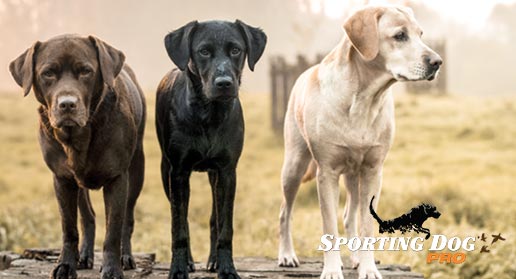
The AKC recognizes three coat colors: black, yellow, and chocolate. Black is the most common in working field lines. All three colors appear in both working and show lines, and coat color has no documented relationship to temperament, trainability, or field performance despite persistent amateur theories to the contrary. Choose based on breeding quality and working background — not color.
The Lab’s double coat requires relatively little grooming but does shed, particularly during seasonal coat changes. The dense undercoat that provides thermal insulation in cold water is the same coat that turns up on furniture and in vehicles. A well-maintained Lab coat is clean and water-resistant; a Lab that swims frequently and isn’t bathed periodically can develop a notable odor from the coat’s oil.
Health considerations
Hip and elbow dysplasia are the primary heritable health concerns in the breed. Labs are among the most commonly affected breeds for both conditions, and OFA or PennHIP hip certification on both parents is the minimum standard to ask for when purchasing a puppy from a working or field background. The connection between hip dysplasia and a shortened working career is direct — a Lab with significant hip dysplasia will lose field capability earlier and require more management to maintain quality of life.
Obesity is the other major health issue in Labs. The breed has an exceptional appetite and no reliable self-regulation around food — Labs will eat until the food is gone, regardless of whether they need it. Weight management through measured feeding and consistent exercise is essential and directly affects joint health, working longevity, and overall quality of life.
Is the Lab right for you?
The Lab is an excellent choice for the waterfowl hunter who wants a reliably capable field partner and a stable family companion — the same dog for both roles. It is also an excellent choice for the family that wants a trainable, gentle, socially oriented dog with the energy level to keep up with an active household. It is not the right choice for someone expecting a dog that requires minimal exercise or that can be left largely inactive without behavioral consequences. A Lab that doesn’t get adequate physical and mental engagement develops the same behavioral problems any working breed develops: destructiveness, restlessness, and difficult management.
The combination of trainability, temperament, and field capability that has made the Lab the dominant breed in North American waterfowl hunting for a century is real. It’s the result of selecting for working ability across many generations, and it’s why the breed continues to earn its reputation in every duck blind, every training session, and every family that takes the time to do right by one.