You have no items in your shopping cart.
Healthy Puppy Development - What to Expect

A puppy’s first year covers more developmental ground than any other period in his life. The dog he becomes — his confidence, his trainability, his social behavior, his relationship with people and other animals — is largely shaped by what happens during these early months. For a gun dog owner, understanding what’s happening developmentally at each stage helps you make the right decisions about socialization, training, handling, and veterinary care at the right times. Most of what goes wrong with working dogs in later life can be traced back to something that either happened or didn’t happen in the first year.
Birth to 8 weeks — the breeder’s window
Puppies are born deaf and blind, fully dependent on their mother. The first three weeks are almost entirely about sleeping, nursing, and physical development — the puppy’s eyes and ears open between two and three weeks of age, and he begins to move around and interact with his littermates. During this period, the mother manages everything: feeding, warmth, elimination stimulation, and the first social lessons of the litter.
The period from roughly three to eight weeks is when the most important early socialization happens — within the litter, with the mother, and with humans who handle the puppies. A breeder who handles puppies regularly during this window, introduces mild novel stimuli (different surfaces, gentle sounds, brief separation from the litter), and provides early enrichment is doing developmental work that pays off for the dog’s entire life. Puppies handled frequently and positively during this period are more confident, less reactive, and easier to train as adults than puppies raised in isolation.
Eight weeks is the earliest appropriate time to move a puppy to a new home for most breeds, and there’s a reason for it. The littermate relationship and the mother’s social teaching are still active during weeks five through seven. Removing a puppy too early — before six weeks — has been associated with increased anxiety, aggression, and difficulty with bite inhibition later in life. A reputable breeder will not let puppies go before eight weeks.
Your first vaccinations begin during this period. Most puppies receive their first distemper/parvovirus combination vaccine around six to eight weeks, often administered by the breeder before the puppy leaves. Confirm this record when you pick up the puppy and bring it to your veterinarian at the first visit.
8 to 12 weeks — the critical socialization window
The period from eight to roughly fourteen weeks is the most important socialization window in a dog’s life. During this time, the puppy’s brain is in a developmental state that allows positive exposures to form deep, lasting associations. Things the puppy encounters during this window with positive or neutral outcomes are likely to be accepted comfortably for life. Things he doesn’t encounter during this window may require more effort to introduce positively later.
For a gun dog, this window is the time to introduce him to the sounds, sights, and environments he’ll eventually work in: vehicles, different terrain, water, people of different ages and appearances, other dogs, livestock if relevant, and — carefully and at appropriate distances — the sound of gunfire. None of this needs to be formal training. It’s exposure in low-pressure contexts where the puppy can process new things at his own pace with positive outcomes.
The puppy is also highly impressionable to fear during this period. A single significant fright can leave a lasting negative association that’s hard to reverse. Keep new exposures positive and manageable. Don’t flood the puppy with overwhelming stimulation and don’t force him into situations he’s clearly frightened by. Gradual, positive exposure in this window produces a confident adult dog. Forced exposure to overwhelming stimuli produces the opposite.
The second vaccination visit typically occurs around twelve weeks. This is also when to discuss heartworm prevention, flea and tick control, and any region-specific vaccines (leptospirosis, Lyme) with your veterinarian.
The socialization window doesn’t close entirely at fourteen weeks, but the ease and depth of socialization drops significantly. Whatever positive exposure work you can do in the first three months after bringing the puppy home is the most valuable training investment available. It costs nothing but time and attention.
4 to 6 months — foundation work and the fear period
By four months, a puppy is capable of learning basic commands and beginning the foundation obedience work that field training will build on: sit, stay, here, and basic leash manners. Attention span is short and distractibility is high — keep sessions brief, five to ten minutes of focused work, and end on successes. Don’t push into advanced behaviors before the foundational ones are solid.
This is also the time to address bad habits that, if left unchecked, become harder to break: jumping on people, biting and mouthing, ignoring recall, counter-surfing. Small habits practiced daily become large habits by twelve months. Consistent, clear correction of unwanted behaviors now is significantly easier than addressing those same behaviors in an adult dog that has been practicing them for a year.
Many puppies go through a secondary fear period somewhere between eight and twelve months — a developmental phase where they may suddenly become reactive or cautious about things they previously accepted without concern. This is normal and temporary. The correct response is patient, positive re-exposure rather than forcing the puppy through the fear. A puppy that goes through a fear period and is handled well comes out the other side more confident. A puppy that is pushed or punished during a fear response often carries that fear long-term.
The third and final puppy vaccination series typically occurs around sixteen weeks. A rabies vaccine is usually given between twelve and sixteen weeks. Your veterinarian will confirm the specific schedule based on your location and your dog’s individual history.
6 to 12 months — adolescence and advancing foundation
The six-to-twelve-month period is adolescence, and it looks much like adolescence in any species: established behaviors become less reliable, the dog tests boundaries, distractibility increases, and the handler who hasn’t built a solid foundation discovers that gaps in early training are now more expensive to address. A puppy that learned commands reliably at four months may seem to forget them at seven. This is normal, frustrating, and temporary — but the response should be patient consistency and enforcing the rules he already knows, not assuming the training failed.
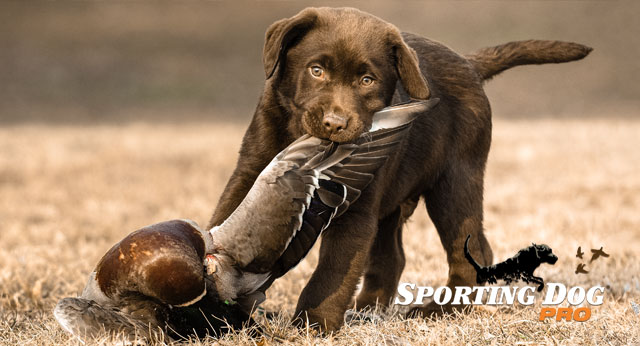
For sporting breeds, this is when prey drive, pointing or retrieving instinct, and the drive to follow scent begin expressing themselves more clearly. These instincts are assets to be channeled, not problems to be suppressed. A six-month-old retriever puppy that carries everything in sight and brings it toward you is showing you the raw material of a finished hunting dog. A pointing breed puppy that freezes on a bird smell is showing you his natural ability. These expressions of instinct during this period are the foundation your field training will build on.
Most working dog trainers introduce the e-collar somewhere in this window, after basic obedience is reliable and the puppy has developed enough to understand the communication. Browse our family dog and starter collar systems for low-to-medium output options appropriate for young dogs in their first year of collar work.
Physical maturity and mental maturity are not the same thing. A sporting breed may reach full size by twelve months but won’t be mentally mature until eighteen months to two years. Don’t let physical size push you to advance training faster than the dog is mentally ready for. The dog that matures at his own pace and is trained accordingly will be more reliable at three years than the dog that was rushed.