You have no items in your shopping cart.
Do You Have What It Takes To Train Your Dog?
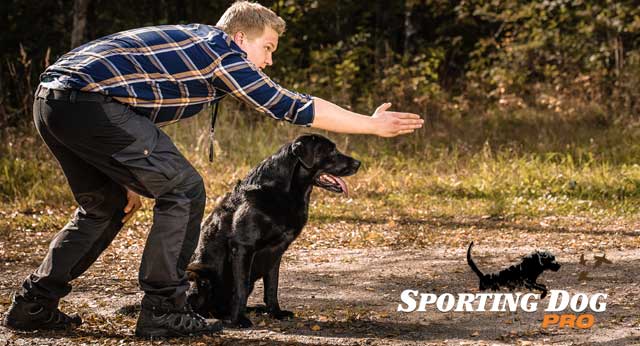
Most hunters decide they want to train their own gun dog before they even pick up the puppy. That instinct is right — the relationship you build through the training process produces a different kind of partnership than handing the dog off to someone else and picking him up finished. But self-training a gun dog requires more than desire. The questions below are worth answering honestly before you start, because knowing your own limitations going in is how you avoid the mistakes that are hardest to fix later.
Are you willing to start with a blank slate?
You are not training the dog you imagined. You are training a puppy who knows nothing, has zero impulse control, and will test every boundary you set within the first week. The genetics and breeding you selected matter enormously for what the dog will eventually become — but at eight weeks old, none of that is visible yet. You will be working with chaos before you work with potential. If you expect a young puppy to behave like the finished dog you’re picturing, you will be frustrated constantly. If you accept that you’re building from nothing, you’ll be in the right frame of mind.
Are you willing to enforce rules consistently?
Training without enforcement is just suggestions. A dog learns the rules only when the rules are applied every time, by everyone who handles him. If you enforce the sit command and your spouse doesn’t, the dog has learned that the command is optional depending on who’s asking. If you correct a behavior in the yard but ignore it in the house because you’re tired, the dog has learned that the rule changes by location.
This is harder than it sounds because it requires discipline from the handler, not just the dog. Are you willing to interrupt a conversation to enforce a command? To stop what you’re doing and follow through even when it’s inconvenient? Consistency is the most important quality in a dog trainer. It matters more than technique, more than equipment, more than natural ability.
The most common reason self-training fails isn’t the dog — it’s the handler losing patience or consistency before the behavior is fully built. Short, frequent sessions over many months outperform intensive bursts every time.
Are you willing to look critically at what you’re doing wrong?
When a training problem persists, the first place most handlers look is the dog. The right place to look first is the mirror. Dogs don’t fail training. Handlers fail dogs. A recall that doesn’t work is almost always a timing problem, an inconsistency problem, or a foundation problem — all of which belong to the handler. A dog that won’t hold steady has usually been allowed not to hold steady enough times that the behavior has been trained out of him.
Being a good self-trainer requires the ability to step back from a session that isn’t working, identify what you’re contributing to the problem, and adjust. That requires honest self-assessment and the willingness to be wrong. It also requires knowing when to get outside help — a second set of experienced eyes can identify handler errors in minutes that the handler has been repeating for months without recognizing them.
Are you willing to adapt to this specific dog?
The method that worked on your last dog may not work on this one. Two dogs from the same litter, same breeding, same upbringing can have completely different temperaments, different sensitivities, and different learning styles. The bold, high-drive dog who shrugs off a correction needs a different approach than the sensitive dog who shuts down at the slightest pressure. Matching your training to the dog in front of you — rather than the training program you read about or the dog you had before — is what separates effective handlers from frustrated ones.
Flexibility matters especially around stimulation levels if you’re using an e-collar. Finding the working level for each individual dog rather than assuming a number from your last dog is fundamental. A quality training collar with fine stimulation gradations — like the 127-level rheostat on Dogtra systems or the precise dial on a SportDOG SportTrainer 1275 — gives you the precision to dial in accurately for each dog rather than guessing.
Are you patient enough to let the dog develop on his timeline?
Rushing a gun dog is one of the most common and most damaging mistakes in self-training. Taking a dog hunting before he’s ready — before the obedience foundation is solid, before he understands what he’s supposed to do in the field — doesn’t give him experience. It gives him opportunities to practice the wrong behaviors in the highest-distraction environment possible. A dog that has been hunted over before he’s trained is harder to train than a dog that has never been in the field at all.
Some dogs are ready earlier than others. Physical readiness and mental readiness are not the same thing. A dog that looks the part at 18 months may not be mentally prepared for the pressure and complexity of a real hunting situation. Let the dog tell you when he’s ready, not the calendar.
Do you have the time to do it right?
Training a gun dog doesn’t require hours per day. It requires short, frequent, consistent sessions over a long period of time. Fifteen focused minutes three or four days a week is more productive than a two-hour marathon on Saturday. The short session format matches how dogs actually retain information — they consolidate learning between sessions, and fatigue and distraction in a long session work against you.
What it does require is showing up regularly over months, not weeks. The foundation behaviors need hundreds of correct repetitions before they’re reliable under field conditions. That takes time even with short sessions. If your schedule allows only sporadic training — a burst of effort followed by weeks away from it — you will build and rebuild the same skills repeatedly rather than advancing through them.
A finished gun dog typically takes two to three full seasons to develop. Most of the visible payoff comes in years two and three — which means the handlers who quit in year one never see what they were building.
Are you in it for the long haul?
A gun dog that performs reliably in real hunting conditions isn’t a one-season project. It typically takes two to three full seasons to develop a finished, dependable dog that handles varied terrain, game types, and hunting pressure consistently. Most of the visible progress happens in years two and three, after the foundation was laid in year one. Handlers who quit or get frustrated in year one never see what they were building.
The question isn’t whether you can commit to training sessions. It’s whether you can commit to the full arc of developing a dog through multiple seasons without losing patience when the early results don’t look like the finished product you’re working toward.
The equipment question
Once you’ve answered yes to the above, equipment matters — but in a specific way. The right tools make your communication with the dog cleaner and more precise. They don’t do the training for you. A training collar from a quality manufacturer, a set of retrieving dummies, a check cord, and a whistle are the foundational tools for most gun dog training. Choose them, learn them, and use them consistently. The handler who buys new equipment every time a training problem appears and blames the collar for things the collar had nothing to do with is avoiding the harder work of examining his own approach.
Equipment that fails is almost always a handler problem. The collar that “doesn’t work” is usually being used at the wrong level, with the wrong timing, on a behavior the dog doesn’t yet understand. Get the fundamentals right and the tools do their job.
When you’re ready to build your training kit, browse our training collar guide and training gear lineup. Call us at 1 (800) 524-2428 if you want help choosing the right setup for your dog and your training goals.