You have no items in your shopping cart.
Choosing The Perfect E-Collar
The e-collar market has more options than most buyers realize when they start looking, and the differences between systems are real — not just marketing. A collar that’s right for a close-working family dog is meaningfully different from what a hound hunter running dogs across miles of open country needs. Getting clear on a handful of key criteria before you start shopping makes the decision straightforward. Getting them wrong means spending money on a system that doesn’t fit your application.
Application: the first and most important question
How you use the collar determines which features matter. Before looking at any specific system, get clear on your actual use case:
Family dog / general obedience. A dog that works within sight, on your property or nearby, and primarily needs basic obedience reinforcement doesn’t need a 1-mile collar. What matters here is a lower output range with precise stimulation levels, reliable performance at short-to-medium distance, and a system that’s comfortable for daily use. Our family dog collar category is organized around exactly this use.
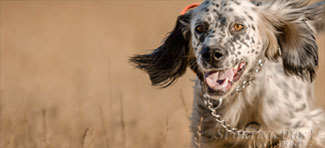
Upland hunting. A pointing or flushing dog working upland cover needs a collar with beeper integration or beeper/e-collar combination capability, sufficient range for the terrain you hunt, and waterproofing for wet conditions. Range requirements vary significantly — a close-working Brittany in thick cover needs less range than a wide-ranging setter in open ground. Our upland beeper collar category covers systems built for this application.
Waterfowl hunting. A retriever working in and around water needs full waterproofing rated to IPX7 or IPX8, sufficient range to reach a dog that has swum well out into open water, and reliable signal transmission over water. Combination e-collar and GPS systems are increasingly popular for waterfowl applications where knowing the dog’s exact location in marsh or open water matters. See our waterfowl collar category.
Hound hunting. Dogs that can run miles — coonhounds, beagles, bird dogs on a big cast — need maximum range, and often multi-dog capability from a single handheld. GPS integration is standard equipment in the hound hunting world for exactly this reason. Our hound hunting collar category covers long-range systems with multi-dog capability.
Range: buy what you actually need
The original article is right that having too much range doesn’t hurt, but having too little does. The practical guidance: think about the farthest distance at which you’d realistically need to communicate with your dog in a real hunting or training scenario, and buy a collar with comfortable margin above that.
Manufacturer range specs are typically measured in ideal conditions — flat open terrain, no interference. Real-world range in heavy timber, rolling hills, or wet marshland is meaningfully shorter. A collar rated at 500 yards open-field may reliably reach 300 yards in the cover you actually hunt. If your application is close work, this doesn’t matter. If you need maximum range in difficult terrain, buying a collar rated well above your target distance is worth it.
For multi-dog households, also consider whether you need one transmitter to control multiple receivers. Most serious multi-dog systems allow a single handheld to control two, three, or more receivers simultaneously. Some lower-cost systems require a separate transmitter per dog, which gets unwieldy and expensive.
Stimulation levels and output
The number of stimulation levels a collar offers matters more than many buyers realize. A collar with 8 levels gives you coarse adjustments. A collar with 32 or 100 levels gives you the fine-grained control to find the precise working level for each individual dog — which is the level at which the dog notices the stimulation without being startled or distressed by it. That working level varies significantly from dog to dog and from situation to situation.
Output intensity matters too. High-output collars designed for strong, distraction-resistant dogs used at the lowest levels can still be too much for a sensitive breed like a Brittany or a young dog in early training. Lower-output collars with fine level control are generally better for sensitive dogs and puppies. Higher-output systems with wide level ranges cover both ends — the sensitive young dog at level 3 and the hard-headed mature dog at level 18 on the same system.
Waterproofing
For any hunting application that involves water — which is most of them, including dew-soaked upland cover — waterproofing is not optional. IPX7 is the standard minimum for hunting dogs: submersible to 1 meter for 30 minutes. IPX8 offers deeper submersion rating for dogs that make repeated deep-water retrieves. Check both the receiver and the transmitter — some systems waterproof the receiver but not the transmitter, which matters if you’re hunting in the rain.
Combination systems
Several manufacturers now offer e-collar systems with integrated GPS tracking, beeper functionality, or both. These combination units reduce the number of devices on the dog’s neck and the number of handhelds in your vest, while giving you more complete information about what the dog is doing and where she is. For hunters who already run multiple collar systems, the upgrade to a combination unit often pays for itself in reduced complexity.
The tradeoff is cost and, occasionally, capability — a purpose-built beeper may offer more beeper features than a combination system’s beeper function. Evaluate what you actually use versus what the specs promise. For most hunters, a well-chosen combination system eliminates the collar stack entirely.
Our training collar guide organizes the full lineup by application — family dog, upland, waterfowl, hound, and professional — with brand information and system details for each category. Call us at 1 (800) 524-2428 if you want to talk through which system fits your specific situation. We’d rather you get the right collar the first time than buy the wrong one.
Brands on our shelves
We carry SportDOG, Dogtra, Garmin, and DT Systems — four of the most established names in the e-collar market, each with distinct strengths. SportDOG builds excellent all-around systems at strong price points, particularly for waterfowl and retriever applications. Dogtra is known for precise stimulation control and fine level increments, making their collars a frequent choice for professional trainers and sensitive dogs. Garmin leads in GPS integration, and their Alpha and Astro systems are the benchmark for hound hunters who need reliable location data alongside e-collar function. DT Systems offers solid waterproof systems with strong value. We don’t carry brands we don’t stand behind, and our phone is available at 1 (800) 524-2428 if you want a recommendation from someone who knows the products.