You have no items in your shopping cart.
A Begging Dog Is A Bad Gundog
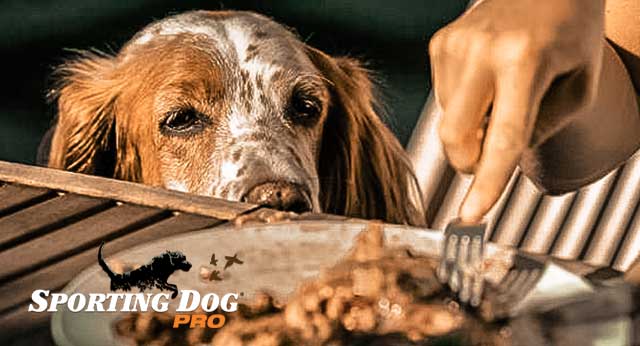
A begging dog at the dinner table is annoying. A begging dog in a hunting camp, around other people’s food, jumping on guests, or pestering kids with plates is a problem. But for a gun dog specifically, begging is more than a nuisance behavior — it’s a symptom of a broader issue with control and impulse management that shows up in the field in ways you don’t expect.
A dog that has learned he can demand food from you by being persistent enough has learned that persistence pays. That lesson transfers. The dog that won’t leave you alone at the table is often the same dog that breaks point early, creeps on a marked bird, or won’t hold steady at the flush. The impulse control problem and the begging problem have the same root. Fix one and you’re working on both.
Why dogs beg even when they’re not hungry
Dogs are opportunistic feeders by nature. In the wild, a dog that passed up available food because he’d already eaten didn’t survive as well as one that ate whenever food was accessible. That instinct is still fully intact in your well-fed Labrador. He isn’t begging because he’s hungry — he’s begging because food is present and accessible and that instinct says to pursue it. Understanding that the behavior is instinctual rather than manipulative helps you respond to it correctly: it doesn’t need sympathy, it needs a clear rule and consistent enforcement.
Why human food is genuinely bad for dogs
Beyond the behavior problem, what you’re feeding matters. A dog’s digestive system is built differently from ours in ways that make human food problematic regardless of how healthy it is for you.
Dogs have significantly higher stomach acid than humans, which is designed to break down raw meat, bone, and dense protein — not the cooked, processed, carbohydrate-heavy food that makes up most human meals. Human food prepared for our digestive system is often already pre-broken-down in ways that hit a dog’s gut hard. The result is frequently digestive upset, loose stools, or diarrhea — not because the dog is sick, but because the food wasn’t designed for him.
Some common human foods are outright toxic to dogs: onions and garlic in any form, grapes and raisins, xylitol (found in many sugar-free products), macadamia nuts, and chocolate. Others that seem harmless — rich fatty foods, spiced meats, cooked bones — cause pancreatitis or blockages. The risk isn’t just the occasional treat escalating to obesity over time. A single serving of the wrong thing can send your dog to the emergency vet.
Beyond toxicity, regular table scraps undermine the nutritional balance of a diet that was carefully formulated for a working dog. A high-performance gun dog needs specific ratios of protein, fat, and nutrients — particularly during hunting season. Supplementing that diet with whatever’s left on your plate disrupts it. You wouldn’t spend money on a quality performance food and then undercut it with junk. The same logic applies here.
The connection to field performance
For a gun dog, the table manners problem and the field control problem are the same problem expressed in different settings. A dog that has been allowed to demand things from you — food, attention, access — by being persistent and pushy has been taught that he can negotiate. That negotiation shows up as creeping on point, breaking at the flush, not honoring, ignoring the whistle when he’s onto something interesting. The dog isn’t being bad in the field. He’s applying the same strategy that worked at the dinner table.
Control is not contextual for dogs. A dog that understands and accepts your authority does so everywhere — at the table, in the kennel, and at 200 yards in a field with birds in front of him. A dog that has learned to push boundaries at home will push them in the field. Building clear expectations around food, access, and impulse control at home directly supports the work you’re doing in training.
How to stop begging
Don’t start. The easiest solution is to never feed from the table in the first place. A behavior that never gets reinforced never develops. If you have a puppy, establish the rule now and hold it with everyone in the household. One person who sneaks the dog scraps undoes everyone else’s work.
Place command during meals. A dog on a place command — a bed, a mat, a kennel — during mealtimes is not in a position to beg. This is the cleanest solution for a dog that already has the behavior established. It puts him somewhere specific with a clear expectation and removes the opportunity entirely. The place command is worth teaching for this reason alone, apart from any field application it has.
Pick up food you drop. Every scrap that hits the floor and gets eaten is a reinforcement. A dog that learns the floor around the table is a food source will patrol it. Pick up drops before he gets to them, especially with young dogs learning the rules.
Never reinforce persistence. If your dog begs and you eventually give in to stop the behavior, you’ve taught him that persistence works — he just needs to hold out long enough. The timing of the reward is irrelevant to the dog. He connects the treat to the begging behavior that preceded it, regardless of how long it took. The only effective response to begging is no response at all, consistently.
Feed him separately. Feeding your dog while you eat seems logical as a distraction but usually doesn’t work. He eats faster than you do and is back at the table before you’re through your first course. Feed him after your meals are done, in his spot, with no connection to what was on your plate.
If you’re working on obedience and impulse control with your dog, the same training that addresses begging builds the foundation for field work. Browse our family dog training collar lineup for systems suited to obedience training and everyday control — or call us at 1 (800) 524-2428 if you want help choosing the right fit for your dog.